
A Contribution to the Historical-Materialist Approach to the Origin of Class and Caste and Their Abolition
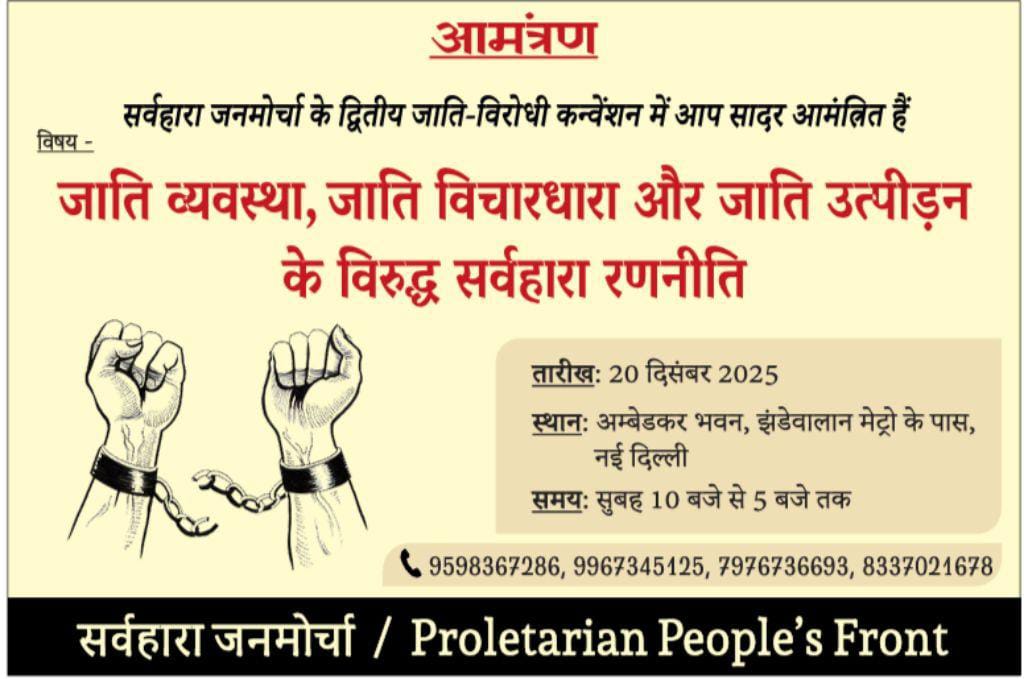
(Base Paper for the 2nd Anti-Caste Convention organised by Proletarian People’s Front (PPF)/सर्वहारा जन मोर्चा on 20th December 2025 in Ambedkar Bhawan, New Delhi)
I
Whenever we confront history with a question like ‘how did the varna/caste system originate’ or ‘how can it be abolished’, the question ‘which of the two – class or caste – appeared first in human history’ immediately crops up in our mind, followed by a volley of other pertinent questions: when and how did the modern human species arrive, survive, live, procure and start producing food – not only food but also surplus food – with which they organised themselves as civilised social beings and began their journey towards civilisation? Marx writes: “The first premise of all human history is, of course, the existence of living human individuals. Thus the first fact to be established is the physical organisation of these individuals and their consequent relation to the rest of nature… (hence)* the writing of history must always set out from these natural bases and their modification in the course of history through the action of men.”(From The German Ideology) Human history is thus nothing but the narration of changes that have taken place in the life of the human species since its birth on this planet in relation to the rest of Nature, which has also been modified by the intervention of man and his physical organisations over millions of years. Hence the task of caste annihilation, before it really becomes a revolutionary practical task, first presents itself as a rigorous theoretical task: arriving at the correct historical-materialist approach to understanding the key to the development of human civilisation in general and Indian civilisation in particular. Only after this does the varna/caste system appear on the scene – to be precise, around 1100–1000 BCE, after the demise of the Indus Valley Civilisation (~1900 BCE) which was also the first Indian urban civilisation. What is notable is that the coming of the first urbanites (IVC) is marked by relaxation in earlier religious rituals and cults. Religion was markedly subdued compared to both earlier Neolithic/Chalcolithic cultures and later Vedic society. Ritual activity existed, but it was neither elaborate nor dominant. Crucially, there is no evidence of classes being ritually or religiously ossified. We find no varṇa or caste-like birth-based, hereditary, ideologically frozen hierarchy. In short, although religion did play some role in legitimizing the authority of the surplus-appropriating elite, it did not occupy a central place in the polity or the ruling dispensation. The cohesion, expansion, and prosperity of the IVC rested primarily on centralised administrative and economic power at the top, not on a priestly or ritualised class/caste system.
(This * always indicates indicates the words added by the present author.)
Since class division long predates the era of civilisation, varna/caste appeared much later than classes. A close examination of Indian prehistory from the Palaeolithic to the Indus Valley Civilization (c. 3300–1900 BCE) shows that class divisions and surplus appropriation by non-producers emerged well before the rise of urban civilization — already during the later phases of the Neolithic Revolution (c. 7000–3800 BCE) which correspond with the three stages of development at Mehrgarh –the village that saw all the phases of the Neolithic Revolution and lastly started decaying after 3800 BC. Mehrgarh was geographically close to the Indus basin.
As far as the emergence of varṇas is concerned, they emerged in an entirely different historical context, around 1100–1000 BCE (mentioned in the latest Rigvedic hymn, Puruṣa-sūkta, RV 10.90) – roughly a millennium after the collapse of the Indus Valley Civilization. This is the period when Steppe-derived, semi-nomadic, pastoralist Vedic Aryans from Central Asia entered the Greater Punjab and gradually consolidated their political, linguistic and religious dominance over the fragmented, village-based, late/post-Harappan agro-pastoralist populations. At the point of origin, the four varṇas (Brāhmaṇa, Kṣatriya/Rājanya, Vaiśya, Śūdra) were nothing but embryonic class divisions, and there is virtually no serious scholarly debate on this now, except the rather childish claim that the varnas, castes, the Śūdras, the Untouchables or the Outcastes, all suddenly appeared with Indian feudalism or just before it as it was the foreigners who had brought them to India. However, embryonic class-division didn’t come with varnas. Rather it was already present, even before the introduction of the formal varṇa scheme that included Śūdras, so that, Rigvedic society was already divided along class lines – Purohita and Rājanya (priests and warrior-chiefs) as rulers and surplus-appropriators, and the Viś (commoners) as primary producers as well as cattle-herders. Not only this, tribal structures co-existed with this incipient class stratification in the agro-pastoralist economy of that period.
___________________________
Irfan Habib’s writings (see The Vedic Age) clearly establish these things. To prove that the life of the Rigvedic people was not essentially pastoral, he not only refers to Rigveda, but also cites an example ofa ploughed field found at Aligrama (an archaelogical site in the Swat Valley of North-Western Pakistan), datable to the eleventh century BC. He says that the archaeological finds in the region of the Rigveda (the Indus plains and north western borderlands) during the period preceding 1500 BC tell us about agriculture and not only pastoralism so that ‘any laying of over-emphasis on the pastoral sector would be hard to justify.’ Rather, ‘the pastoral sector was important because of the requirements of agriculture.’ He also says that surplus was produced and appropriated. The classes who appropriated the surplus and held it ‘in their possession were those of the rulers and the priests – the later Kshatriyas and Brahmans.’ It makes it quite clear that the Rigvedic society, even before the varnas appeared, was divided on class lines. Citing verses in Rigvedic hymns (VIII, 35, 16-18 and 1, 113, 6), he clearly says that ‘class-differentiation between those who ruled or pursued their gain and those who just laboured is here manifest.’ About division of society into tribes (for which the word jana, also meaning people, was sometimes used; for example, the Pancha Janah, ‘the Five Tribes’, or Yadva-jana, ‘the Yadu tribe’. The Rigveda provides us with as many as thirty names of different tribes), he says that these tribes ‘seems to have cut across this simple class structure.’ Dwelling much on the composition of the tribe, he finally says that ‘the social division within the tribe seems to have been along the lines of classes rather than lineages.’ This is however contradicted by RS Sharma whose views are buttressed by Suvira Jaiswal by every possible means. Their combined effort nevertheless betrays the truth. Quoting the well known remarks of Marx that man-hunting was the logical extension of animal-hunting, RS Sharma accepts that ‘the egalitarian ethos of the Rigvedic tribes was undermined by the unequal distribution of booty by the tribal chiefs (Suvira Jaiswal’s Caste: Origin, Function and Dimensions of Change, page-139). He further says that ‘there was a differentiation of ranks, but no class differentiation’ (ibid), but just after two sentences, he had to come to terms that the polity was ‘moving gradually towards greater differentiation, as is indicated by the danastutis’ that forms the latest stratum of Rigvedic literature. It indicates that ‘a major share of the spoils was cornered by chiefs and priests leading to an inequitable redistributive system.’ Not only this, Suvira Jaiswal herself says that ‘clear evidence for a three-fold social differentiation comes from Book VIII of the Rigveda’ in which ‘we see a tripartite functional division, presumably in hierarchical order’. But this one is most important – ‘the development of a powerful priesthood and the formation of the brahman varna may not be simply a case of ethnic predisposition; greater availability of surplus (which cannot come without people engaging themselves in agriculture*) and enforced leisure are necessary conditions for the proliferation of rituals and the growth of a class of specialists who first establish their control over the great fertility rites and then assume the role of intermediaries between clans and ancestors and deities. The process may be seen in the Rigveda’. And finally, she says, ‘Rigvedic society was a simple society in which ranking depended more upon personal qualities and skills, not wealth or status inherited at birth.’ However, ‘what was derived from achievement and experience’ came to be based ‘on heredity and mythical/ritualistic considerations’ by the end of the Rigvedic period, a development which receives explicit authentication in the later Vedic sources.’ The outcome is that Irfan Habib, RS Sharma, DD Kosambi and Suvira Jaiswal all converge to a single view: the social division within the tribe seems to have been along the lines of classes rather than lineages. There are many references to bali in the Rigveda. A close study of these references tells us that bali was an imposed tribute and not voluntary offerings. Irfan Habib writes that ‘we do not, however, know how it was levied, and in what forms it was paid; it is likely that not just cattle, horses and gold, but also agricultural produce formed part of it.’
____________________________
Now, from where and how did the Śūdras come on the scene after which Varna scheme had had to emerge? The bulk of the defeated indigenous populations (c. 1100–1000 BCE) that also included pre-Vedic Aryans already mixed up with the local late Harappan population and settled there (together called Dāsa/Dasyu in the Rigveda) were reduced to the status of Śūdras — the main source of both servile and productive labour. However, assimilation was differential: some defeated groups were incorporated as Brāhmaṇas, Kṣatriyas or Vaiśyas as well. Thus, the varṇa system arose as an ideological cloak superimposed on already existing class divisions before varna scheme. In other words, varṇas were built over pre-existing classes. Later, the ruling strata (Brāhmaṇas and Kṣatriyas) ritualised and religiously ossified the varṇa in order to perpetuate their domination indefinitely. Functions and roles were permanently fixed by birth and heredity; varṇas became genealogically closed, stratified and rigid. Yet, with changes in productive forces and class relations, even these “rigid” varṇas continuously changed their actual role. Some examples are: firstly,with the coming of iron technology and wet-rice cultivation in the upper and middle Gangetic plains, surplus extraction soared, and with this Śūdras (along with Vaiśyas) became the direct producers in agriculture, before which the Śūdras were mainly the source of servile labour; secondly, massive surplus extraction from agriculture with the coming of Iron Age gave rise to craft specialisation and development of new crafts in separate centres leading to growth of towns and long-distance trade, which later laid the foundation of the Second Urbanisation (6th–4th century BCE) which gave rise to new classes such as artisans, traders and merchants, etc; thirdly, under the Mauryan empire during which the second urbanization peaked, Brāhmaṇas largely became salaried state officials while Kṣatriyas turned into monarchs commanding standing armies; fourthly, thewealthier Vaiśyas became full-fledged merchants, where as the poorer or less prosperous and successful sections were increasingly pushed down into the Śūdra category; fifthly, Śūdras largely became dependent free peasant cultivators. When taxation became unbearably heavy in the later Mauryan period, mass peasant (mainly Śūdra) revolts and tax refusal contributed significantly to the empire’s collapse, and from the Gupta period onwards, extensive land grants to Brāhmaṇas transformed many of them into feudal landlords, while the old Kṣatriya warrior aristocracy was partly replaced or supplemented by new regional dynasties. In short, throughout history the actual economic functions and class content of the varṇas (and later jāti clusters within them) kept changing in accordance with the development of productive forces and shifts in production relations — even though the ideological carapace of birth-based, ritually sanctified varṇa hierarchy was repeatedly invoked to freeze and legitimise the new reality.
Therefore the task finally crystallises into something very concrete: we need to inquire and, on the basis of this inquiry, ascertain the role of development in the physical structure of the human species from Homo habilis to Anatomically Modern Man, as well as the development of tools – first for procuring food from Nature while enduring harsh and unstable ecology for millions of years, and then for producing food – including surplus (more food than the producers themselves needed for bare subsistence) – since the Neolithic Revolution, in the over all historical development of Indian society up to now, in which the question of surplus appropriation by non-producers is the most important and fundamental factor – one which has determined not only the emergence of classes and class rule but also the emergence of varnas and castes that were built over classes. Inasmuch as we need to do this in order to deal with the question of caste annihilation in the context of the very intimate and dynamic relation of ‘class’ with ‘caste’ (or vice versa), this is undoubtedly a matter of ultimate necessity.
II
Scientific inquiry into human history has proved that the beginning of agriculture is the foundation of all civilisations; that is, agriculture is the foundation upon which the era of civilisation began. However, the era of civilisation coincides with the era of consolidated class division. To be more precise, the era of civilisation is nothing but class-stratified civilisation, and it began only when humans not only started producing food but also surplus on a regular basis and in such quantity as required storage, so that it could be centrally appropriated to keep civilization going. In India such a material condition existed around 3300–2600 BCE when the foundations of the Indus Valley Civilisation were being laid. To put the same thing theoretically: when early modern humans started not only producing food but also surplus, the mechanism of appropriation of that surplus by non-producers or by the ruling elite or classes arose along with it. Later they established their right of appropriation either by force, or by religious beliefs that legitimised this appropriation, or by both.
Here it must be noted that the rise of formalised form of religion is different from that of religious beliefs and customs which has its roots in ignorance of the savagery period (Upper Palaeolithic age). It predates even the emergence of any kind of visible social division of labour. The struggle to find the answer of what happens after death had begun just after the arrival of true Anatomically Modern Man (Homo sapiens sapiens), who now had a well evolvedbrain, lungs and vocal cord, almost like those of ours, and hence considerably improved his capacity of speech and thinking. Having no knowledge of modern biology, particularly of the modern anatomical structure and functions of his own body, he fell to the superstitious belief in after-life and immortality of soul, to which he attributed every feeling (pain, hunger, thirst, love, hate, etc) of his body before death. However, it was just the beginning, and only laid the first brick of foundation for future religion to grow as an idealist philosophy that explains existence of everything in this universe. Even the Rigveda, though a religious text, was only the beginning of formalised religion in India. From the later Vedic corpora to the Upaniṣads it gradually evolved into a formalised religion. To conclude, in the Indian context what we know as religion today is the formalised form of religion based on innumerable rituals that later got supplemented by other religious literatures, including the Manusmṛti, which made it not only different from Upaniṣadic religion but also the most reactionary religion.
We know, as we have discussed above, urbanisation originates new classes and gives mobility to old ossified classes and castes. That is why it is linked to, and has witnessed, the birth of religious and caste flexibility in both the first and the second Indian urbanisation. In the Indus civilisation we find fewer religious rituals; the religion itself was zoomorphic and did not grow anthropomorphic. The second urbanisation saw a great rise in opposition to varna-rigidity, birth-based hierarchical status gradation and rituals – despite the fact that classes had only changed their mode of existence and exploitation.
However, if urbanisation and civilisation continue to grow without the existence of classes (such as in a society in which means of production are fully socialised), then caste, caste system and the religion legitimising them would certainly not remain.
What we have seen, however, is that the process of urbanisation in India has collapsed midway – not once but many times. Its careful study offers a concrete explanation up to the rise of feudalism: whenever centralised control ceased to exist, either the speed of urbanisation reduced or it stopped altogether and collapsed. We see more or less the continuation of this trend, with urbanisation emerging again and again, until the arrival of British conquest after the Battle of Plassey in 1757 and the British takeover of India in 1858. The British conquest and takeover present a different picture inasmuch as England had become an imperialist country and made India a raw-material appendage of the British Crown.
If we look at present-day modern capitalist civilisation, it seems certain that it is either on the verge of destruction (due to the possibility of nuclear war in the wake of surging inter-imperialist contradictions) or on the verge of complete regression (due to the rise of fascism that will soon take society back to medieval barbarity and monarchical order) – both because of the internal crises of the capitalist-imperialist mode of production. The rise of fascism also means wars of aggression – against its own people inside the country and against the people of other (weaker) countries. The former is legitimised by the latter, which is portrayed as patriotism. Both lead to war, and destruction by both routes is possible if change in the social system does not take place soon enough.
To connect with the past discussion: classes at a particular juncture gave rise to varnas, and the same classes, now in the form of the capitalist-imperialist class, have given birth to the possibility of complete destruction of human civilisation. Thus, the task of abolishing caste becomes conjoined with the task of saving the human civilisation and keeping it on the path of constant historical progress. Two tasks combine here into one.
Secondly, the dangers that threaten modern civilisation today are far more serious than those that threatened civilisation in earlier times. Then, even after the collapse of civilisation, the base – agriculture and craft or trade – was saved. What fell mainly was the centralised mechanism of surplus extraction. Local-level production and extraction/appropriation of surplus from agriculture continued. This is what happened in the case of the IVC and in all periods after the fall of the Mauryan Empire. Things that were part and parcel of village life and its class structure remained intact. The accounts of one of the most powerful non-Aryan tribal chiefs, Śambara, possessing one hundred forts (called puras, made of stone and unbaked mud-bricks), and another named Varchin heading multitudes of troops prove that even after the fall of the IVC and before the beginning of Vedic society the village-level structure was embryonically a class structure. The Vedic society and civilisation grew and built over this class-divided structure only. It must be noted here that while classes and private property appeared with the first surplus-producing societies, the state – which monopolises ‘legitimate’ violence and territorial bureaucracy – appeared particularly with the rise of urban civilisation, the simple reason being the impossibility of the existence and expansion of an urban civilisation without centralised state control.
III
Anyway, who were the first surplus appropriators? They were the priestly and warrior classes, whose roots lie in the ecology of the then agro-pastoralist and cattle-herder life. One small part of the population – the priests and warriors – socially emerged as caretakers and protectors of the tribe. The priests prayed and sang to external agencies for the general good of the tribe, while warriors fought battles and carried out cattle raids to enrich the tribe. For this both took the bigger share of the booty and surplus, and hence held sway over the much larger part of the population who were commoners – producers or cattle-herders or both. This happened in every part of the world wherever modern humans lived and started their journey to civilisation from scratch.
In India the Rigvedic society (1500–1000 BCE) shows a similar three-fold functional division-based society: priests, warriors and commoners, which were in actuality embryonic class divisions cloaked in tribal rank structure. After the defeat of the Dasa/Dasyu tribes, and their integration into the Varna system as the fourth category of servile as well as productive labour (Sudras), the above embryonic class division cloaked in ranks was transformed into embryonic class division cloaked in varnas that, just a few century later, broke the so called egalitarian tribal structure once and for ever. One must mark it that without the integration of the Śūdra and the deeply-felt need to transform the Śūdras into a permanent source of productive labour in the context of the opening up of the huge potential of surplus extraction from massive wet-rice production in the upper and middle Gangetic plains, as well as without the deep desire of the Brahmans and Kshatriyas of perpetuating their rule for ever, there could have been no Varna system. It was the combination of the above-mentioned need and desire that Varna system was introduced which brought social repulsion and distancing from the very beginning, although commensal and connubial restrictions came later. Varna rigid startification and its further differentiation into castes (whose main features are hereditary labour division, endogamy and untouchability) began later, it is true, but they began only because the Varna system had these tendencies from the very beginning.
_______________________________
Suvira Jaiswal also says that there are many shades of opinions (such as those of Dumont and Ambedkar also) that are ‘used to paint an idealised picture of the varna scheme as having been initially an open, dynamic division of labour which later degenerated into a closed segmental hierarchy.’ Hence she feels it deeply that ‘their validity needs to be examined.’ She feels it particularly because ‘it has a bearing on the placement of the Untouchable castes on the margins of the varņa-divided society.’ She doesn’t stop here and says that ‘it is not without significance that the terms varņa and jāti have been used indiscriminately in the brahmanical law-books of the first decade of the Common Era as well as medieval texts such as the Varņaratnākara (14th century CE) written in Mithila.’ She correctly mentions that among Hindus, although jāti evolved much later, it is commonly used to ‘refer to all levels of the caste system beginning with varņa.’ The reason is that, she says, ‘both categories were defined and demarcated on the same principles, i.e., hereditary occupation, exclusiveness in matters of connubial and commensality and hierarchical status gradation’ and hence ‘even Manu asserts that there are only four jātis and there is no fifth (Manusmrti X.4) and speaks of fifteen lowly mixed castes as fifteen varņas (ibid. X.31).’ According to her, the very first use of the word ‘varna’ in the Rigveda was meant to draw a sharp distinction between the Arya and Däsa tribes. So, when they introduced four-fold varna-system or scheme by bringing the bulk of the defeated Dasa tribes’ people into its fold, the word ‘varna’ again meant sharp distinction. In the words of Suvira Jaiswal, the same word ‘varna’ ‘was applied in later vedic times to the emerging four-fold social divisions to emphasise their cleavage and separateness on a hereditary basis.’ However, what Suvira Jaiswal forgets to mention is that even before the varna scheme came, the Rigvedic society was divided on class lines in the form of priests and warrior-chiefs as appropriators and the viś as the direct producers and herders. When she says that ‘as long as priestly functions, warfare or productive occupations like cattle-raising had not become genealogically determined hereditary professions the term varņa was not used in relation to them’, she forgets that they were classes in themselves, and as such, the appropriators priests and warrior-chiefs must have had class-biases, and based on such biases, some initial social repulsion and distancing, too. However, she is true when she says that ‘the Rigveda does not speak of brahmaņa, kşatriya or vaiśya as varņa categories and even the precedence of the priest in such a scheme is not fixed in the initial stages, as is exemplified by Rigveda (I.113.16)’ and ‘the varņa stratification is clearly seen in later vedic texts characterised by all the three major features of the caste system- hereditary occupation, status gradation and sub-ordination and instrumentalisation of the female sex’ (bold in the quote added), first through the practice of hypergamy and later through endogamy, ‘for the stability of social hierarchy.’ And therefore, ‘there is no attempt to conceal the fact that the entire edifice (of varna scheme*) rested on the exploitation of the producing and labouring classes, to which end the priestly class devised umpteen rituals and the warrior nobility used its arms, both groups joining hands to keep the vaiśya and the śūdra varņas under control.’ (see The Emergence of Castes and Outcastes, page – 8,9)
_______________________________
Thus, classes not only predate varnas but also act as their prerequisite: varnas were built upon existing classes only. Secondly, as told above, although there were no fixed boundaries between the varnas in the beginning, social repulsion and distancing existed even then – and it was natural. Soon commensal and connubial restrictions also came. Around 400 BCE, according to Suvira Jaiswal, Pāṇini speaks of Śūdras who are not expelled or excluded from communion with the Aryas (aryāṇām aniravasitānām II.4.10). It implied that there were Śūdras who were excluded from such communion. His commentator Patañjali later explained that the Caṇḍālas and Mṛtapās were niravasita, i.e. excluded Śūdras who did not live within Aryan settlements, villages, towns, etc., and vessels used by them for eating food became permanently polluted and could not be purified even by fire. (ibid, see page 12,13)
The point is that while it is true that the emergence of jätis within the framework of varņas is a later phenomenon, its basic features – particularly the tendency of social repulsion and distancing against a section of Śūdras – existed from the very beginning. Probably because of this, as Suvira Jaiswal says, that ‘the earliest jäti/ caste like subdivisions within a varņa category are seen among those who are dubbed as śūdras by the brahmanical thinkers. (ibid)
IV
However, at this stage one more thing needs to be investigated with priority: why did the Steppe-derived Aryan migration to India lead to the establishment of Vedic ritualistic religion and the varna system? In the words of Suvira Jaiswal: what was the process which led to a precise defining and institutionalization of statuses, their crystallization into varna categories? And of course, why did it not produce the same in Europe and Central Asia?
We can use scholarship of DD Kosambi to answer the first question. His view was that it was the brahmana varna with its gotra organization that developed first as ‘a result of interaction between the Aryan priesthood and the ritually superior priesthood of the late Indus Culture’, while the survivors of the Harappa Culture were absorbed at various levels in the composite Aryan society, thus evolving the four-fold varna structure as a consequence. Most crucial was the assimilation of the Harappan priesthood in which small groups of pre-Aryan priests joined the conquering Aryan clan groups offering them their priestly services. The recombined priesthood transformed the original Vedic priesthood which was unified with Kshatriyas. It accelerated its separation from the ksatriya elite. It was a structural development that took place parallel to the emergence of the Dasa/ Sudra caste and led to endogamy, first among Brahmans. Individual property had not developed sufficiently among the nomadic pastoral Aryans, but as now the subjugated Harappan agrarian population i.e. those engaged in agriculture (identified as Dasas by Kosambi) belonged to the conquering tribes as a whole constituting a separate group, private property became part and parcel of the life of the Aryan people also. This was how the integration between Aryans and non-Aryans took place and the Dasa/Sudra varna originated, and also an endogamous caste system came into existence.
However the second question remains to be answered: why did the Steppe-derived Aryan migration not produce the same varna system in Europe and Central Asia? Actually, the real answers of both the questions lie in the ecology as well as the concrete historical specific conditions of the areas in the given period.
It is true that these Steppe-derived Aryan tribes also went to Europe and Central Asia (BMAC – Bactria–Margiana Archaeological Complex), but they did not produce a highly ritualised religion and a varna-system linked with it. In Europe, at the time of their arrival, the continent was populated with dense Neolithic farmer communities in temperate forest/river areas. The migrants caused massive genetic replacement and thus rapidly assimilated into local farming communities – same as what happened as the resultof the first wave of Aryan migration. This eliminated the need for a priestly monopoly or a birth-based fourth varna (Śūdras) as a huge servile and labouring mass. The result was fluid tribal hierarchies (Celts, Germans, etc.), which later gave rise to European feudalism under Christianity.
In Central Asia, Steppe nomadic or semi-nomadic groups fused with BMAC (Bactria–Margiana Archaeological Complex) urbanites, so local priestly traditions (early Zoroastrian) and clan fluidity persisted without break. Additionally, unlike in India, there was no explosion of agricultural surplus (in either Europe or Central Asia) requiring mass control over cultivating and labouring classes of Vaisyas and Sudras in the name of ritualised Varna system. Therefore varna-style ideology did not arise there.
But when they entered the Indian subcontinent they encountered a totally different situation: a post-deurbanised, village-based agro-pastoralist population that stood completely fragmented, disconnected and disunited. Moreover, it (Vedic Aryan wave of migration) was a heavily male migration facing a huge local substrate. Soon, iron-age tools (1000–700 BCE) created a gigantic rice surplus that dwarfed anything in Europe or Central Asia. To control the new millions of producers, as well as to politically unite the whole subcontinent under one umbrella, the Steppe-descended elite turned their tribal priests, as most of them came from pre-Aryans late Harappan culture, into a hereditary corporation and invented the fourth varna, a birth-based hierarchy, highly ritualistic Vedic religion and endogamy.
V
Thus classes, private property and the state made their appearance one after another in human history, whose basis, to repeat it again, was the foundation provided by the beginning of agriculture. If we limit ourselves to ancient times, we can see it happen primarily in two phases. The first phase belongs to the “First Indians” – Ancient Ancestral South Indians (AASI) arriving in India some 65,000 years ago as hunter-gatherers – who sparked the Neolithic Revolution (7000 BCE at Mehrgarh), mixed with Iranian-related farmers (4700–3000 BCE, 50–70 % ancestry in IVC clines) and pioneered the first-ever urbanisation centred in the Indus basin (3300–1900 BCE).
The second phase belongs to the Steppe-derived Indo-Aryan-speaking Vedic tribes’ migrations to the Indian subcontinent between 1900-1500 BCE. The Vedic Aryans, constituting the later waves of Aryan migration, came in circa 1500 BC, while the pre-Vedic Aryans, constituting the first wave of Aryan migration, came in circa 1900 BCE when the IVC was already in tatters, and fused or mixed up with Late Harappan populations (Cemetery H, Jhukar cultures). These Aryan groups established Vedic religion (~1500 BCE), integrating via conflicts like the Battle of Ten Kings (1400–1200 BCE), where Bharata tribes defeated a coalition of Aryan (Puru, Anu) and non-Aryan (Dāsa/Dasyu/Pāṇi) foes for dominance – first in Punjab till ~1000 BCE, and later in the upper and middle Gangetic plains through gradual eastward expansion from ~1000 to ~800 BCE.
Iron tools (~1000–700 BCE) boosted agriculture and surplus, laying the foundations for janapadas (800–600 BCE) and mahājanapadas (600–300 BCE), where territorial kings and, under them, a communal mode of ownership (emerging out of the tribal mode which could not cope with the massive production of rice surplus in the upper and middle Gangetic plain and needed a system of control over millions of new cultivating population) emerged and channelled surplus-extracted resources into separate centres of craft/trade, thus igniting the Second Urbanisation (600–300 BCE).
The Mauryan Empire (321–185 BCE), with centralised administration akin to the IVC’s though dhamma-infused, harnessed this for peak urbanisation before it collapsed around 185 BCE. After this the second urbanisation gradually disappeared. This period of urbanisation coincides with the birth and expansion of Buddhism and Jainism. It also connects the dots: urbanisation creates the material basis for increased mobility of old and new classes, allowing space for varna and religious flexibility and some motion in the ossified varna/caste system, causing tremors. This must be noted in the course of understanding the onward march of the history of varna/caste. It also links to our discussion that urbanisation cannot continue or be carried further without centralisation of power at the top.
Trade boomed during the Kushan centralisation period. Kushan and Satavahana gold and silver coins show enormous commercial wealth, but it remained centrally non-taxable and hence contributed little to the imperial treasury so that urbanisation could be carried forward. Instead, religious tax-free land-grants to both Brahmans and Buddhist monasteries exploded from the 1st century CE onward. The land once granted was alienated from the royal treasury, and so was the land revenue. Thus de-urbanisation became the order of the day.
By the time Chandragupta I took power in Magadha (~320 CE) he had inherited an empty treasury and a countryside dotted with tax-free Brahman villages. His son Samudragupta (335–375 CE) tried the old imperial model of leading huge war campaigns for tribute to fill the treasury, but he failed. By the time Chandragupta II (375–415 CE) rose to the throne it was all over for the Golden Gupta Empire. He had to introduce the feudatory system (institutionalised decentralisation in place of the ongoing spontaneous decentralisation), with subordinate kings turning into samantas who kept local revenues. Additionally, he accelerated land grants to Brahmans, temples and officials and introduced hereditary governors for provinces and district officers for districts. In the given situation these posts also turned into little kingdoms.
The sum total of these developments in this period turned the “Golden Gupta Empire” into a confederacy of feudal lords owing nominal allegiance to the Gupta throne. At the time of the Huna invasions after 450 CE the samantas simply switched allegiance or fought on their own. By 550 CE the Gupta Empire dissolved into a pattern of warring regional feudal kingdoms – a loose suzerainty of different types of feudatories and grantees. This is how the birth of Indian feudalism took place. Thus, the old communal mode of ownership headed by empires was replaced by the feudal mode of ownership based on feudal private property, with the result that urbanisation was pushed back for a long time to come. Not to mention, the old urban centers collapsed.
The journey to feudalism, covering almost 700 years from the fall of the Mauryas to that of the Guptas, is accompanied by a Brahmanical reaction beginning with the Śuṅga dynasty itself – the immediate successor of the Mauryas. Stratified varnas were resurrected once again, as suggested by post-Vedic Brahmanical literature like the Brāhmaṇas and Manusmṛiti.
Let us recapitulate the connecting dots.
Varna rigidity in the Later Vedic Period (1000–700 BCE) had its material basis in massive wet-rice agriculture in the upper and middle Gangetic plains, which exploded the old tribal controls (priests–warriors–commoners). The ideological response was the consolidation of the Śūdras – first mentioned in the latest Rigvedic hymn (RV 10.90, ~1100–1000 BCE) – as a permanent massive labour force needed for surplus extraction. Accordingly, the Brāhmaṇa texts (Śatapatha Brāhmaṇa, Aitareya Brāhmaṇa, ~900–700 BCE) declared brāhmaṇas “gods on earth”, prescribed endogamy, forbade Śūdras from Vedic study; the Dharma-sūtras (700–500 BCE) fixed occupation by birth and prescribed punishments by varṇa (e.g., pouring molten lead into a Śūdra’s ear if he recites the Veda). Varnas became birth-based, hierarchical and increasingly rigid; with the massive increase in agriculture, endogamous jātis began to multiply.
An ideological challenge came in the form of Buddhism and Jainism, whose material basis was the second urbanisation under the sixteen mahājanapadas. New cities (Rājagṛha, Śrāvastī, Kauśāmbī, Pāṭaliputra) arose, trade boomed, and new social groups (gahapatis, śreṇi merchants, artisans) emerged who did not fit the old four-fold varṇa box. Both Buddhism and Jainism openly rejected birth-based hierarchy. The Buddha declared: “Not by birth is one a brāhmaṇa, not by birth an outcaste; by deeds alone…” (Vāseṭṭha Sutta). Mahāvīra accepted Śūdras and women into the order. Urban kings needed revenue, not purity, so they patronised Buddhist/Jain monks and merchants instead of Brahman villages.
The counter-attack peaked under Ashoka (268–232 BCE): expensive Brahmanical rituals were ridiculed (Rock Edict 9), non-violence and equality of all sects praised (Rock Edict 13), thousands of stupas and monasteries built with state funds. Brahmans were largely sidelined. Varna/caste hierarchy was seriously weakened – especially in the imperial core where urban areas became more fluid and many Śūdra cultivators and artisans rose as gahapatis. Yet society at large remained under Brahmanical influence; Buddhism did nothing to stop Brahmans extracting surplus in the villages. Moreover, Buddhism’s doctrine of karma and rebirth, and the monastic life it demanded, could not be followed by producing villagers. Purāṇic Brahmanism co-opted the karma–nirvāṇa concept, copied devotionalism (bhakti, avatars, temples) and kept caste intact.
Reaction began under the Śuṅgas and continued under foreign invaders (Śaka, Kuṣāṇa) who allied with local chiefs and Brahmans in exchange for tax-free land-grants. The Manusmṛti (200 BCE–200 CE) became the fiercest defence of varna/caste: the Śūdra exists only to serve the twice-born (2.31); mixed castes were listed by the dozen with degrading occupations; the king’s primary duty is to uphold varṇa-dharma (7.35, 8.410–418). A new wave of land-grants began under the Sātavāhanas (100 CE); Kuṣāṇa rulers called themselves “devaputra” and issued huge grants to Brahmans for legitimacy. Genomic studies (2019–2025) show a dramatic drop in exogamy after ~100 CE: endogamy became the rule and castes – including untouchable/outcaste groups – froze completely.
VI
The feudal order born after the Guptas lasted until the Turkish invasions of 1206 CE. Qutbuddin Aibak declared himself Sultan and founded the Delhi Sultanate. Rajput kingdoms were destroyed or turned tributary; the new land-revenue system filled the treasury because there were no more hereditary samantas or tax-free Brahman villages in the conquered zone. It looked like a departure from the past, yet the caste system remained untouched – the new rulers extracted even more surplus (kharaj often higher than the old 1/6th bhaga) and sometimes used Brahmanism to further subjugate Śūdra peasants. Centralisation did cause an urban and trade boom (Delhi, Lahore, Multan became larger than any city since Pāṭaliputra), and urban artisans and merchants gained mobility, but village tax-burden became worse than under the old feudal order.
In 1526 Babur founded the Mughal Empire (1526–1707) – the largest, most centralised land-revenue extracting state the world had ever seen. By Aurangzeb’s time its revenue equalled the entire national income of contemporary England and France combined. The old zamindars were turned into state-appointed revenue-farmers with temporary contracts; failure meant removal and punishment. Their legal profit was only 10–15%. Cash nexus penetrated the village on a mass scale; peasants sold grain to pay silver rupees. Trade and craft boomed, urban wages rose, artisan guilds grew rich. Lahore, Agra, Surat, Dhaka, Machilipatnam became manufacturing giants. Bengal alone exported textiles worth millions of silver rupees every year. The rigid village jajmani system (the caste-based division of labour of the old feudal era) began to crack wherever the cash economy reached. Had this process continued uninterrupted, the old feudal caste order would certainly have dissolved in the sea of commodity production.
But since the Battle of Plassey (1757), the British conquests started and the great progress made during the Mughal Empire was deliberately reversed. The Permanent Settlement (1793) converted revenue-farmers into hereditary private landlords who could extract unlimited rent. Indigenous industry was killed, millions of artisans thrown back onto land, de-industrialisation completed, caste froze again. The British conducted seven full caste censuses (1871–1931), turning fluid jātis into rigid, enumerated all-India castes. Yet, to drain India more efficiently, they built railways, ports, and coal mines. The first modern factories appeared in Bombay, Kanpur, and Jamshedpur. By the 1940s, India had a small but real industrial proletariat — concentrated, disciplined, and getting organised. Thus, the objective as well as the subjective factors needed for the final assault on the caste system had come into existence.
VII
The National Movement momentarily united millions as Indians, not as castes – railway workers, jute-mill hands, rent-withholding peasants, and boycotting students – all felt a unity stronger than caste. That feeling of unity itself was an assault on the caste order. Dr. Ambedkar seized the moment and raised the banner of total caste annihilation.
However, the later day development since Independence smashed that hope. The ringing slogan “land to the tiller” was buried under weak pro-landlord pro-bourgeois “land-reforms”; 70–80 % of the land stayed with the old upper-caste and rich-peasant elite. Śūdra and Dalit cultivators remained labourers or share-croppers. Untouchability was banned on paper (Article 17), but no revolutionary rupture in production relations took place from below. Reservation enriched a tiny layer; the vast majority remained landless, debt-crushed and ritually oppressed.
Partition killed 10–15 lakh in communal carnage organised, in many places, by the Hindu Mahasabha, RSS and the Muslim League. All walked free and after independence RSS even placed a man in Nehru’s first cabinet. The Nehruvian era built steel mills on the backs of the same landlords and a new rich-peasant class fattened by the Green Revolution. Telangana (1946–51) and Naxalbari (1967) tried to turn the world upside down, but both were drowned in blood. In 1991, the betrayal reached zenith. Manmohan Singh by introducing NEP opened the floodgates of profit for big monopolists and the magnates of finance capital: billionaires multiplied, slums exploded, regular jobs vanished, and the rural Dalit poor sank deeper.
In 2014 came the final assault of monopoly finance capital fused with Hindutva. A new bloc – old upper-caste elite plus bourgeoisified sections of OBCs, EBCs, even some Dalits and Adivasis united with the fascists against Muslims, landless labourers, factory workers, toiling peasants and slum-dwellers, against democracy itself – has appeared as the new ruling social combination.
Caste ideology now works through new type of fusion. Rich strata from oppressed and oppressor communities now sit at the same table of profit; when material interests align, bourgeoisie of different caste origins crystallise into a new caste bloc. Today’s “Hindu Rashtra” project is the latest crucible of such fusion – Modi’s regime and the RSS are forging a fascist cage.
Yet the only force that can smash it is the one born in British railway workshops and cotton mills, whose fifth generation – overwhelmingly from oppressed-caste origin – today toils in unorganised sectors, construction sites, fields and bastis with little or no regular income. Uniting with proletarians of upper-caste origin and other faiths, it is evolving into a multi-caste, multi-faith revolutionary proletariat. Extreme loot by monopoly finance capital has made the poor and lower-middle classes of all castes so desperate that a new fission (poor vs rich inside every caste) and a new fusion (unity of all exploited across caste) are emerging despite the constant pumping of caste ideology.
Comrades and friends!
The entire journey from the Stone Age to the present teaches one thing: Caste was born in history and is kept alive by capitalism (imperialism being its highest stage). The granary is still locked, but the lock has rusted. The classes that wore the mask of varna/caste for three thousand years now stand naked. The real producers face them as the modern proletariat – no matter what name history gave them earlier, today they are proletariat in irreconcilable contradiction with every section of the capitalist class, irrespective of caste, religion or community.
Therefore, the next and final step of caste annihilation belongs to the proletariat, just as the abolition of classes belongs to them. The day they call themselves by their true name – proletariat – the day they refuse crumbs and demand the whole bakery, that day will be the last day of the ruling classes and their caste system. Reforms and reservations are okay, but they enrich a few and leave millions in the mud. The need of the hour is the call for total emancipation. When the proletariat, allied with all toiling classes, marches towards power, caste and class will both perish in the same flame. A new humanity will be born.
Early humans had no choice but to accept the path of civilisation that produced ‘appropriators’ and ‘appropriated’, tribes, classes, estates, nationalities, castes, etc. It happened spontaneously. Yet the proletariat is the final link in the chain of classes – the final product of civilisation, just as the capitalist class is. There is no further subordinate variety of Man to come. If history moves forward, the next society will have the proletariat as its master. If the wheel is forced backward under fascism, we return to barbarism and a naked class rule of monopoly finance capital cloaked in Hindu Rashtra – intensified suffering under a reinforced caste system.
Beyond the world of castes lies the world of classes, and the final link is the proletariat. That solves the riddle of who will break the last barrier of caste.
The division of the proletariat into castes and identities is an organisational difficulty that can only be solved by fusing anti-class and anti-caste struggle into a single stream. Anti-class struggle is by its very nature anti-caste; if it is not, it is fraud. Anti-caste struggle that is not simultaneously anti-class is also fraud. That is why today’s so-called caste leaders who claim to champion social justice never utter a word about caste abolition or annihilation.
Only the proletariat can and will break the chain of classes that produced castes, and throw it away as garbage – abolishing all classes and their imprints. It will open a chapter with no exploitation, subordination, discrimination or inequality. It will not be entirely new: the earliest humans till the Upper Palaeolithic, Mesolithic and early Neolithic were classless and casteless. The proletariat in power will reap all social wealth – land and all other means of production – bring them under social ownership, master technology, and make humanity classless and casteless again without returning to the Stone Age. All will work for all. Individual interest will coincide with collective interest. Private property will be limited to personal consumption. Division of labour will be abolished; the town–country divide will vanish.
Caste abolition ultimately depends on whether the working class seizes power and abolishes classes or not. The working-class revolutions of the first half of the twentieth century, especially the experience of proletarian rule in the Soviet Union, proved it is possible. The moment the proletariat becomes the ruling class it ceases to be a class in the real sense of the term – it has no particular interest other than the general interest of the whole society and toiling humanity. The proletariat in power will also express it by declaring: who does not work shall not eat; wage slavery is banned; productive assets belong to all collectively; consumption is first according to labour contributed, later according to need. The blind laws of nature cease to operate; a society built for human emancipation, not profit, becomes a reality.
Therefore, the rise of the proletariat to power is the arrival of revolutionary Man who ends the era of ‘appropriators’ and ‘appropriated’ – Man who carries neither class nor caste imprint. Only on such a material premise can castes wither away completely, vanish from memory across generations of the transition from socialism to communism.
One must remember that caste and class are both continuities of the past, but class is the longer and more fundamental continuity. Caste has had to realign again and again with changing class relations; it remains only because class remains. Abolish class and caste meets the same fate.
It is true, anti-caste struggle is needed inside class unity so that class struggle remains unpolluted by caste prejudice and caste mentality. It must become the acid test of real class unity. The real challenge – and the task of this convention – is to fuse anti-caste and anti-class struggle inside and outside the movement, in theory and in daily practice. We call upon our dear participants: let us together gear the convention towards this end.
In the end, we place the following proposals (whose detailed explanation is given in the endnote) for approval by the convention. Suggestions are always heartily welcome.
- Fight to raise the demand of Right to Resist and launch mass awareness campaigns against caste oppression and untouchability.
- Build an anti-caste ideological movement by
(a) raising the demand for redistribution of social wealth, including land, in proportion to the contribution of social labour;
(b) raising the banner “One who does not work shall not eat”;
(c) raising the banner of a proletarian state that will fulfil the above demands and clear all obstacles to their fulfilment by imposing the dictatorship of the proletariat;
(d) constantly raising the ideological banner of caste abolition by organising country-wide rallies on a fixed date every year;
(e) building anti-caste organisations on proletarian lines;
(f) leading campaigns geared towards the abolition of both caste and class;
(g) raising the banner and idea of caste annihilation in all state-level and general elections so as to raise the anti-caste consciousness of the people.
- Fight for socialist land reforms. This will free the land from private ownership. Under proletarian rule, land will be cultivated collectively by those who contribute their own labour, and thus the very basis of caste oppression in the villages will be liquidated.
- Encourage and celebrate inter-caste marriages and fight for full and complete freedom to marry the partner of one’s choice instead of the restrictions imposed presently in both the religious personal and civil marriage laws. Although this alone will not abolish caste, it will help break the rule of endogamy, which remains the main pillar of the inseparable ideologies of caste and patriarchy today.
- Fight for socialisation of all urban residential land to provide public housing for all to end discrimination in housing, especially rental housing, on caste and communal lines. Equitable distribution of all rural residential land and guarantee of housing to all.
- Fight for guarantee of universal equal public entitlements for education, healthcare, transportation, entertainment, etc to end present extreme inequality marginalising oppressed caste people.
- Intensify revolutionary campaigns as the key link of all social struggles.